Deltoid Ligament Ankle What You Need to Know and When to Seek Help

Updated: Jun 29

Deltoid ligament ankle injuries involve damage to the strong ligament complex on the inner (medial) side of the ankle. While less common than lateral (outer) ankle sprains, deltoid ligament injuries can be more serious and are frequently underdiagnosed. Without appropriate assessment and rehabilitation, they may lead to chronic pain, instability, and long-term functional limitations.
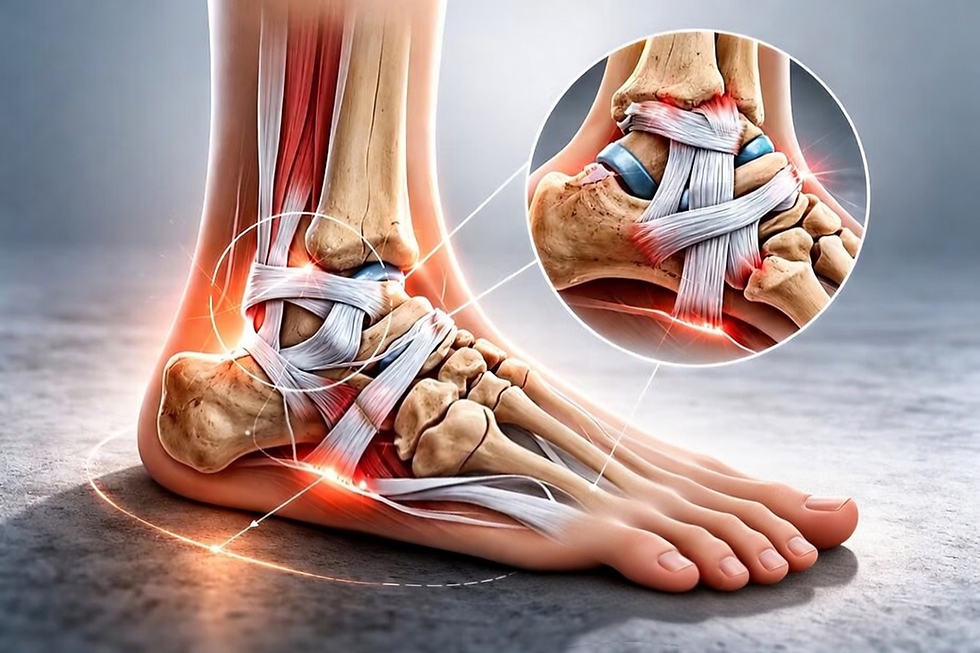
The deltoid ligament, also known as the medial collateral ligament of the ankle, is a broad, fan-shaped structure connecting the medial malleolus (inner ankle bone) to the navicular, calcaneus, and talus bones. It consists of both superficial and deep fibres that stabilise the ankle and subtalar joints, particularly during weight-bearing activities such as walking, running, and jumping. Its primary role is to resist excessive outward rolling (eversion) of the foot and prevent inward tilting of the ankle. Because of its strength, significant force is usually required to injure it.
Deltoid ligament injuries commonly occur during forced eversion movements, such as awkward landings, stepping off a curb incorrectly, or contact sports. They may also accompany more severe ankle trauma, including fractures or high-energy impacts like falls and motor vehicle accidents. In some cases, repetitive stress from activities like trail running, football, basketball, or dance can contribute to medial ankle overload. Importantly, deltoid ligament injuries often occur alongside other ankle damage and may be overlooked if attention focuses solely on lateral sprains or fractures.
Like other ligament injuries, deltoid ligament sprains are graded according to severity:
Grade 1 (Mild Sprain): Microscopic fibre tearing with intact structure. Symptoms include localised tenderness, mild swelling, and manageable discomfort during walking. Recovery is generally straightforward with rest and guided rehabilitation.
Grade 2 (Partial Tear): More significant fibre disruption causing swelling, bruising, pain with weight-bearing, and some joint looseness. Walking may be difficult, and structured physiotherapy is usually required. Recovery often takes four to eight weeks.
Grade 3 (Complete Rupture): Full-thickness tear leading to marked instability, severe swelling, widespread bruising, and difficulty bearing weight. While some cases may require surgical review, particularly if fractures are present, many respond well to conservative management including immobilisation and physiotherapy.
Timely assessment is crucial. Untreated or poorly managed deltoid injuries can result in chronic medial ankle instability, characterised by repeated episodes of the ankle “giving way,” ongoing discomfort, and reduced confidence during activity. If you are experiencing these symptoms, it’s important to book a physiotherapy assessment to determine the extent of the injury and begin appropriate treatment.
The ability to walk after injury depends on severity. Mild sprains may allow modified walking with some discomfort. However, moderate to severe injuries can make weight-bearing painful and potentially harmful. Attempting to continue normal activity without proper evaluation risks worsening the injury, affecting surrounding joints, and creating compensatory movement patterns. Immediate medical or physiotherapy assessment is recommended if there is inability to bear weight, significant swelling or bruising, instability, sharp pain with movement, or visible deformity. Even milder injuries that persist beyond 48–72 hours warrant evaluation to rule out fractures or complete tears.
Diagnosing a deltoid ligament tear requires more than symptom observation, as signs can overlap with other ankle conditions. Key indicators include pain and tenderness along the inner ankle, swelling and bruising on the medial side, pain with outward rolling of the foot, instability on uneven ground, and difficulty with single-leg tasks. Severe cases may involve a “popping” sensation at the time of injury.
A definitive diagnosis involves a detailed history, palpation of the medial ankle, range of motion and stress testing, gait assessment, and potentially imaging. X-rays help exclude fractures, while MRI can evaluate soft tissue damage. However, imaging findings must be interpreted alongside clinical assessment to form an accurate diagnosis.
Treatment depends on injury severity and associated damage, but most cases respond well to conservative physiotherapy-led rehabilitation.
Immediate Management (First 48–72 Hours):Early care focuses on reducing swelling, protecting the ligament, and managing pain using PRICE principles (Protection, Rest, Ice, Compression, Elevation). Ice may be applied for 15–20 minutes every two hours initially. Elevation and gentle compression assist with swelling control. If fracture is suspected or weight-bearing is impossible, urgent medical review is necessary.
Rehabilitation Phases:
Phase 1: Pain and Swelling Control Gentle mobility exercises, manual therapy, neuromuscular reactivation, and possibly taping or bracing are introduced to maintain movement and reduce stiffness.
Phase 2: Strengthening and Stability Focus shifts to strengthening the calf complex, tibialis posterior, intrinsic foot muscles, and surrounding stabilisers. Balance and proprioception training are essential because ligament injury can impair joint position awareness, increasing re-injury risk.
Phase 3: Functional Return to Activity Rehabilitation progresses to sport or activity-specific drills, agility training, and gradual load exposure. This stage restores confidence, capacity, and resilience for daily or athletic demands.
Preventing deltoid ligament injuries involves several proactive strategies. Strengthening the ankle and lower limb muscles provides dynamic support to the joint. Balance and proprioception training improves neuromuscular responsiveness to sudden perturbations. Wearing appropriate footwear suited to the activity and foot structure is important, and orthotics may help individuals with biomechanical risk factors such as flat feet or excessive pronation. A gradual return to sport or training after injury significantly reduces re-injury risk compared to relying solely on pain levels as a guide.
Some individuals develop chronic medial ankle instability following incomplete rehabilitation. This condition involves persistent instability, recurrent giving-way episodes, and discomfort on uneven surfaces. It may occur if associated injuries were missed or neuromuscular control was not fully restored. Chronic instability is treatable but requires targeted reassessment and structured rehabilitation; imaging may be considered if symptoms persist.
In summary, although deltoid ligament injuries are less common than lateral ankle sprains, they can have significant consequences if overlooked. Because of the ligament’s strength and complex structure, injuries often involve substantial force and may coexist with other ankle damage. Early professional assessment, accurate diagnosis, and structured physiotherapy are key to restoring stability, preventing chronic instability, and enabling a safe return to activity. If you are experiencing inner ankle pain, swelling, or instability after an injury, a professional assessment can help identify the severity of the damage and guide your recovery. Early treatment reduces the risk of chronic ankle instability and helps you return to activity safely. Book a physiotherapy appointment with our team to receive a personalised assessment and rehabilitation plan.