Ankle Ligaments: Understanding Injuries, Symptoms, and When to See a Physiotherapist

Updated: Mar 11

Ankle ligament injuries are among the most common musculoskeletal problems treated in physiotherapy clinics across Australia. Whether caused by sport, an awkward step, or ongoing instability, understanding how ankle ligaments function and how injuries are managed is essential for full recovery and long-term joint health.
Ligaments are strong bands of connective tissue that connect bone to bone, providing stability and controlling movement. In the ankle, they prevent excessive motion and protect the joint from damage. When these ligaments are injured, the ankle can become unstable, painful, and prone to repeated sprains.
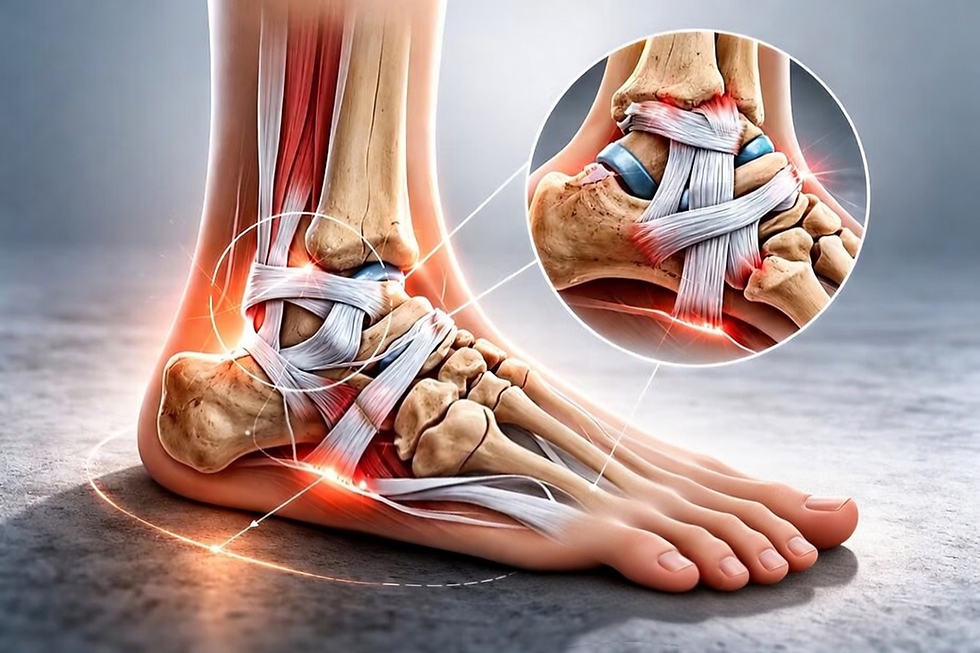
The ankle is supported by three main ligament groups. The lateral ligaments on the outer ankle, the anterior talofibular ligament (ATFL), calcaneofibular ligament (CFL), and posterior talofibular ligament (PTFL) are most commonly injured during an inward roll of the foot (inversion sprain). Due to the direction of force, the ATFL is most frequently prone to injury. On the inner ankle, the deltoid ligament provides strong medial stability and resists outward rolling (eversion). Injuries here are less common but often more serious. The syndesmotic ligaments, located above the ankle joint, connect the tibia and fibula; injury to this area is known as a “high ankle sprain” and typically requires longer recovery.
Common scenarios leading to ankle ligament injuries include landing awkwardly from a jump, stepping on uneven ground, sudden changes of direction in sport, or slipping. However, not all injuries result from a single traumatic event. Repeated minor stress, incomplete rehabilitation of previous sprains, muscle weakness, and poor proprioception (joint position awareness) can lead to chronic ankle instability, where the ankle frequently “gives way,” even during low-level activities.
Several risk factors increase the likelihood of injury, including previous sprains, reduced ankle strength or mobility, high-impact sports participation, poor footwear, and uneven training surfaces. Identifying and addressing these factors is important for prevention.
Ankle ligament injuries are classified into three grades. Grade I is a mild sprain involving microscopic tearing. The ankle remains stable, swelling is minimal, and weight-bearing is usually possible. With appropriate early care, recovery is typically straightforward. Grade II involves a partial ligament tear, resulting in moderate pain, swelling, bruising, and some instability. Weight-bearing may be difficult, and structured physiotherapy is essential for optimal recovery. Grade III represents a complete ligament rupture. Significant instability, severe swelling, bruising, and difficulty walking are common. Although many Grade III injuries can still be managed conservatively, careful assessment is required, and surgical consultation may be considered if instability persists.
Key signs of a torn ligament include sharp pain at the time of injury, rapid swelling, bruising within 12–24 hours, tenderness along the ligament, difficulty bearing weight, and a feeling of instability. Some individuals report a “popping” sensation. Importantly, pain severity does not always reflect injury severity. Because symptoms can be misleading, professional assessment is recommended when in doubt.
It may be physically possible to walk with a torn ligament, but doing so without guidance can delay healing and increase the risk of chronic instability. Attempting to “walk it off” is a common mistake that may lead to cartilage damage and recurrent sprains. Early physiotherapy review is strongly advised, even if weight-bearing is possible.
Ligaments do have the capacity to heal. However, healing without structured rehabilitation may result in weaker or lengthened tissue, leaving the ankle vulnerable to re-injury and reduced performance. Research shows that supervised physiotherapy leads to better long-term strength, stability, and reduced recurrence rates.
The first 48–72 hours after injury are critical. Early management focuses on controlling swelling and inflammation using rest, ice, compression, and elevation (RICE). Proper early care supports optimal tissue healing and reduces long-term complications.
Treatment typically follows a structured, phase-based approach. Phase 1 (Days 1–5) focuses on protection, pain control, and swelling management. Taping, bracing, or temporary use of crutches may be recommended. Phase 2 (Weeks 1–4) aims to restore range of motion, rebuild strength, and retrain proprioception using targeted exercises and possibly manual therapy. Phase 3 (Weeks 4–12+) progresses to functional and sport-specific rehabilitation, including running, jumping, and change-of-direction drills as appropriate. This stage is essential to prevent recurrence.
External supports such as braces, taping, or orthotics may be used, particularly for those returning to sport or managing chronic instability. However, they complement, not replace, rehabilitation exercises.
Chronic ankle instability (CAI) may develop in individuals following inadequately rehabilitated sprains. It is characterised by repeated giving-way episodes, persistent discomfort, and reduced confidence in the ankle. CAI occurs when ligaments heal in a lengthened state and neuromuscular control is not fully restored. Without intervention, repeated sprains increase the risk of cartilage damage and early ankle arthritis. Physiotherapy plays a central role in addressing strength, proprioception, and movement control to restore stability.
Prevention strategies are highly effective, particularly for high-risk individuals. Balance and neuromuscular training reduce sprain incidence by improving automatic muscular responses. Strengthening the peroneals and calf muscles improves force absorption and joint protection. Appropriate footwear and, where indicated, orthotics can improve alignment and reduce excessive stress. Prophylactic taping or bracing during high-risk activities may also reduce injury risk.
You should seek physiotherapy assessment if you cannot bear weight, experience significant swelling or bruising, feel instability, have pain persisting beyond 48–72 hours, or have a history of recurrent sprains. Early intervention is associated with faster recovery and lower re-injury rates.
In summary, ankle ligament injuries are common but highly manageable with appropriate care. Early assessment, structured rehabilitation, and targeted prevention strategies are key to restoring stability, preventing recurrence, and ensuring long-term ankle health.